
History of Brown
Brown’s climate of openness and cooperation can be traced back more than two centuries to its founding as the third college in New England and the seventh in America.
Brown was the Baptist answer to Congregationalist Yale and Harvard, Presbyterian Princeton, and Episcopalian Penn and Columbia. At the time, it was the only one that welcomed students of all religious persuasions (following the example of Roger Williams, who founded Rhode Island in 1636 on the same principle). Brown has long since shed its Baptist affiliation, but remains dedicated to diversity and intellectual freedom.
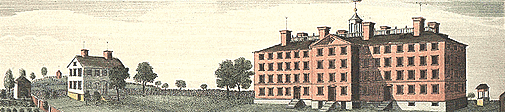
The history of Brown tells of a university constantly undergoing change. Founded in 1764 as the College of Rhode Island in Warren, Rhode Island, the school registered its first students in 1765. It moved in 1770 to its present location on College Hill, overlooking the city of Providence. In 1804, in recognition of a gift from Nicholas Brown, the College of Rhode Island was renamed Brown University. The first women were admitted in 1891, when the establishment of the Women’s College marked the beginning of eighty years of a coordinate structure for educating women within the University. Later known as Pembroke College, the women’s college merged with Brown in 1971.
Graduate study at Brown began in 1850, but was discontinued in 1857. The more modern tradition of graduate study began in 1887, when the faculty and Fellows agreed to publish in the following year’s catalog rules for the awarding of both the master’s and the Ph.D. The first master’s degrees under the new plan were granted in 1888 and the first Ph.D.s in 1889.
In 1811, Brown first organized a medical program, which was suspended in 1827. The first M.D. degrees of the modern era were awarded in 1975 to a graduating class of 58 students. In 1984–85, the Brown Corporation approved an eight–year medical continuum called the Program in Liberal Medical Education (PLME). About half of the openings for the first-year medical class are reserved for students who receive their undergraduate degrees through the PLME. Today Brown awards some 90 medical degrees annually.
Conceived by undergraduates and ratified by the faculty, Brown’s distinctive undergraduate curriculum dates to 1969–70. The curriculum harks back to a philosophy shaped by Brown President Francis Wayland. In 1850, he wrote: “The various courses should be so arranged that, insofar as practicable, every student might study what he chose, all that he chose, and nothing but what he chose.”
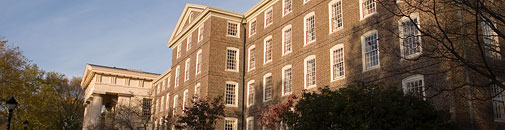
Currently, Brown is embarking on The Plan for Academic Enrichment. This ambitious program builds on Brown’s strengths and establishes new benchmarks of excellence in research, education, and public leadership.